Photo: Gizmodo

Sunday, August 29, 2010

Revealed: the face of Tory Britain

Photo: Rex Features
If you're not familiar with the UK, you may be wondering who this man is.

A newly cast "Dracula"? A villain in a forthcoming Bond film?

No, it's George Osborne, one of the faces of the new "compassionate conservatism" and the UK's Chancellor of the Exchequer (equivalent to Finance Minister).

A recent Guardian newspaper article ran this photo with a story on an analysis of the UK Government's austerity measures carried out by the Institute for Fiscal Studies, a well respected and independent non-profit research institution. They have shown that despite the Con-Dem coalition's best claims of fairness, the welfare cuts mean working families on the lowest incomes – particularly those with children – are the biggest losers. This amounts tthe poorest 10% of families losing over 5% of their income as a result of the budget compared with a loss of less than 1% for non-pensioner households without children in the richest 10% of households.


No one with any sense doubted for a second Tory promises to be the new "champions of the poor." What is galling, for fools such as myself who voted for the Libdems in May, is Nick Clegg and co's propping up of Tory policy that would have had Margaret Thatcher twirling her handbag in joy. 

Wednesday, August 25, 2010

Dragons who risk fanning the flames

Just stumbled across this video of James Caan in Pakistan (those in the UK will know him as one of the "Dragons" from the TV show Dragon's Den, a show in which entrepreneurs invite people with business propositions to make a pitch and then decide whether to invest their money).

I'm willing to stand corrected, but the news report gives the impression that he's flown into his native Pakistan with a fistful of pounds to sort the food distribution problem single-handed.

"The food ends up going to the fittest," he insightfully reveals at the end. What did he expect when roaring into the flood hit areas with a lorry full of supplies? That he would automatically be able to identify and reach those most in need?

Why is that so many individuals in these situations believe they can do better than Governments or aid agencies who have years of experience is such complex logistical operations?

Sunday, August 22, 2010

Tales of the unexpected

I'm in that post-holiday limbo, when the children are yet to go back to school and I delude myself that I will be able to catch up with work and the kids will look after themselves. Working from home does have its advantages though, such as having the radio on in the background without having to worry about whether it will bother anyone.

This morning's Radio 4 background came into the foreground as I listened with increasing interest to Kathy Burke's choice of Desert Island Discs. She spoke about her challenging childhood, brought up on a council estate in north London, mother dying when she was 2, father with drink problem... all the ingredients for future "anti-social behaviour" and "problem families", justifications that were so often thown up by New Labour for the next wave of draconian initiatives.

Except Kathy Burke went on to become an acclaimed actress, winning a best actor award at Cannes. Which begs the question, what is it that leads to some people overcoming childhood disadvantage in adulthood (not necessarily measured by how many film awards you win) whilst others continue to experience as adults poverty and social exclusion?

Many studies have focused on identifying factors which enable resilience and thus either prevent families falling into extreme poverty or from children experiencing the same outcome as adults as their parents. One study, with the snazzy title of Tales of the Unexpected, conducted by social policy and public health experts in the UK, defined resilience as "the process of achieving positive and unexpected outcomes in adverse conditions." 


Unfortunately, public policy generally has very low expectations of the resilience of families living in pòverty. Yet, in working with such families for 8 years in the UK, I was constantly amazed by the fortitude shown by many parents, especially to keep their children out of the care system.


Such a shame then that the Coalition Government seems to be following the New Labour pattern in side-stepping evidence based policy-making when it suits in favour of gimicky measures to grab tabloid headlines. The latest being the resurfacing of plans to withhold benefits from anyone refusing treatment for drug or alcohol addiction. This despite the social security advisory committee finding back in May that withdrawing benefits from drug users would lead them into crime and prostitution.


Not all kids living on north London council estates can go on to receive an award at Cannes. But surely it pays to raise our expectations of the height children and adults living in poverty are able to reach if we understand and trust in their capacity to achieve the unexpected.

Tuesday, July 20, 2010

A lesson in presentation (using Ikea boxes!)

Great post today from Duncan Green on his blog which gave me the pleasure to discover Hans Rosling. What a joy to watch. If only all those who presented in seminars and conferences (me included!) could be so entrancing! Rather than being an onerous task we feel compelled to put ourselves through in the hope of retaining one hundredth of what is said, a Rosling lecture is a lesson in communicating ideas.

That said, he is an economist, and as often occurs in this discipline, at times he leaves me a little cold. Watch it and let me know your opinion, but his way of talking about child mortality is unpleasantly unemotional at times.

In any case, happy watching and learning!

Wednesday, July 14, 2010

Supporting and not undermining community solidarity

One of the pleasures of working at the headquarters of an international organisation is that you frequently meet people from, or living in, the world over. Today, I had the opportunity to spend time with a colleague based in Ougadougou in Burkina Faso.

One thing that struck me was the delicate balance to be achieved between developing a project with families living in extreme poverty and not upsetting the community solidarity that is the social fabric of Burkinabé society. For example, a family receives a micro-grant from a foregin NGO that they may use to buy a bicycle, for example, with the overall goal of generating income. If they fail to prosper as a result of the grant, the next time they are in need of community support, they may face a negative reaction: "You asked les blancs for help but you still didn't manage. Now it's your problem." (If you read French, then see this excellent blog post about solidarity networks in Burkina Faso).

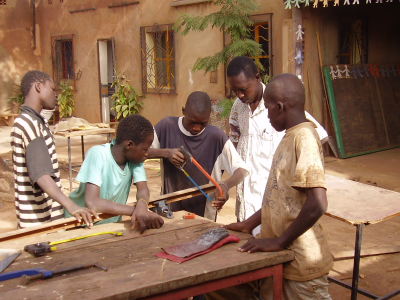
All the more important then for projects to be developed in partnership with those who are too often seen crudely as "beneficiaries". This may take over a year to develop to ensure the conditions of trust are in place that will respect family and community ties. In the example shared by my colleague, a relationship is built up,using books and story-telling as a medium, with a young person, part of a group of youths living in the street in the city. He is invited with others to participate in skill-sharing activities - the “Courtyard of 100 Trades” - a workshop to introduce the youngsters to certain trades. The relationship ultimately leads on to a dialogue with the children’s families, as frequently young people will express a desire to return to their community . The aim at this point is to initiate and support plans for a shared future for the young person and their family. A dialogue is facilitated with the family over the space of several months to understand the support the direct and extended family can offer to ensure the young person's return is a success. In such circumstances, where the family and community dynamic has been understood, the conditions are created for a micro-grant to be made that compliment, rather than replace community solidarity.

And what's more, supporting a young person to return to his community is in harmony with traditional values. As the Mossi saying goes, "You must travel to know the elephant, but then return to explain what it is like."
Photo: ATD Fourth World


Monday, July 5, 2010

Communicating

This week I will be taking part in an internal training session on communication. In order to introduce ourselves to the other participants, everyone has been asked to use something other than a first-person verbal presentation.

That gave me the idea to ask my most loyal and ardent fans - my kids - to describe who I am. You'll find the result below!

Friday, July 2, 2010

There's more to Haiti than the US Military

I just came across this short documentary from US National Public Radio about issues concerning food aid and its effects on the local economy.


It's an intersting piece but it left me thinking: what's the decision-making role of Haitians in the reconstruction of their country? The US Military is rebuilding the port, the World Food Programme is responsible for decisions concerning food aid. Is it uniquely foreigners who are taking action to get the country back on its feet? Again forgotten are the daily efforts of the Haitian people for daily life not simply to return to normal, but to build a more country more inclusive and equal than before.

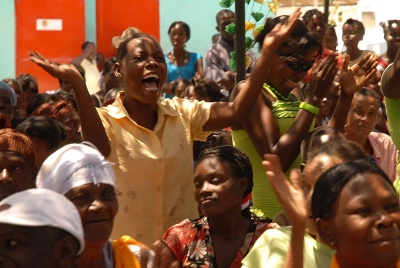
It's another missed opportunity by the media to show that the Haitians are not passive in the wake of the tragedy that befell their country. On the contrary, they seek ways to show their solidarity with their fellow citizens. The organisation I work for bears witness to this, with numerous young people from the community in the Grand Ravine area in which the run projects offering their time to volunteer to support the more disadvantaged members of their community. Their local knowledge has been particularly vital in ensuring that the most isolated and excluded people in the neighbourhood are aware of programmes such as the "cash for work" initiative.

So a plea to the media: focus on the large-scale efforts undertaken by the UN, US Military and the like, but also put the spotlight on the more conspicuous, yet in many ways more far-reaching, undertakings of Haitians to ensure none of their citizens remain left behind.

(Photo: ATD Fourth World)