Photo: Gizmodo

Wednesday, July 14, 2010

Supporting and not undermining community solidarity

One of the pleasures of working at the headquarters of an international organisation is that you frequently meet people from, or living in, the world over. Today, I had the opportunity to spend time with a colleague based in Ougadougou in Burkina Faso.

One thing that struck me was the delicate balance to be achieved between developing a project with families living in extreme poverty and not upsetting the community solidarity that is the social fabric of Burkinabé society. For example, a family receives a micro-grant from a foregin NGO that they may use to buy a bicycle, for example, with the overall goal of generating income. If they fail to prosper as a result of the grant, the next time they are in need of community support, they may face a negative reaction: "You asked les blancs for help but you still didn't manage. Now it's your problem." (If you read French, then see this excellent blog post about solidarity networks in Burkina Faso).

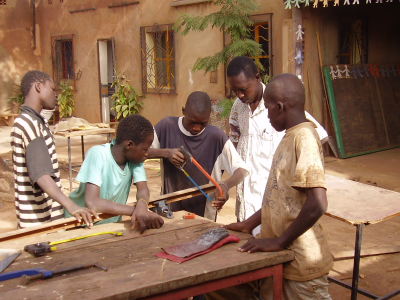
All the more important then for projects to be developed in partnership with those who are too often seen crudely as "beneficiaries". This may take over a year to develop to ensure the conditions of trust are in place that will respect family and community ties. In the example shared by my colleague, a relationship is built up,using books and story-telling as a medium, with a young person, part of a group of youths living in the street in the city. He is invited with others to participate in skill-sharing activities - the “Courtyard of 100 Trades” - a workshop to introduce the youngsters to certain trades. The relationship ultimately leads on to a dialogue with the children’s families, as frequently young people will express a desire to return to their community . The aim at this point is to initiate and support plans for a shared future for the young person and their family. A dialogue is facilitated with the family over the space of several months to understand the support the direct and extended family can offer to ensure the young person's return is a success. In such circumstances, where the family and community dynamic has been understood, the conditions are created for a micro-grant to be made that compliment, rather than replace community solidarity.

And what's more, supporting a young person to return to his community is in harmony with traditional values. As the Mossi saying goes, "You must travel to know the elephant, but then return to explain what it is like."
Photo: ATD Fourth World

Monday, July 5, 2010

Communicating

This week I will be taking part in an internal training session on communication. In order to introduce ourselves to the other participants, everyone has been asked to use something other than a first-person verbal presentation.

That gave me the idea to ask my most loyal and ardent fans - my kids - to describe who I am. You'll find the result below!

Friday, July 2, 2010

There's more to Haiti than the US Military

I just came across this short documentary from US National Public Radio about issues concerning food aid and its effects on the local economy.


It's an intersting piece but it left me thinking: what's the decision-making role of Haitians in the reconstruction of their country? The US Military is rebuilding the port, the World Food Programme is responsible for decisions concerning food aid. Is it uniquely foreigners who are taking action to get the country back on its feet? Again forgotten are the daily efforts of the Haitian people for daily life not simply to return to normal, but to build a more country more inclusive and equal than before.

It's another missed opportunity by the media to show that the Haitians are not passive in the wake of the tragedy that befell their country. On the contrary, they seek ways to show their solidarity with their fellow citizens. The organisation I work for bears witness to this, with numerous young people from the community in the Grand Ravine area in which the run projects offering their time to volunteer to support the more disadvantaged members of their community. Their local knowledge has been particularly vital in ensuring that the most isolated and excluded people in the neighbourhood are aware of programmes such as the "cash for work" initiative.

So a plea to the media: focus on the large-scale efforts undertaken by the UN, US Military and the like, but also put the spotlight on the more conspicuous, yet in many ways more far-reaching, undertakings of Haitians to ensure none of their citizens remain left behind.

(Photo: ATD Fourth World)

Thursday, June 24, 2010

France: The farce continues!

Today a colleague was supposed to be meeting President Sarkozy, alongside numerous other NGOs, at the Elysée ahead of his participation in the G8 and G20 in Canada next week. Among other things on the agenda was France's position regarding the Millennium Development Goals (MDGs), decisions on the progress of which are due to be taken following the September High-level summit at the UN in September.

However, "Sarko" has cancelled as he has more pressing matters to discuss, notably with Thierry "la main" Henry, who was granted a meeting with the President yesterday to discuss the farce which is French football.

Far be it from me to question the priorities of a President, but I happen to think that the millions of people whose lives and livelihoods are dependent on the extent to which Heads of State are properly informed of progress on the MDGs, would probably have prioritised differently.

If you are in any doubt as to the urgency of achieving the Goals that 189 Heads of State set themselves in 2000, then read this Time magazine article. 

Has anyone got Thierry Henry's email so that he can read the article out loud to Sarko?

Wednesday, June 16, 2010

Farewell to a champion of Human Rights (... and rugby, catapults and 2CVs)

Yesterday, people living in extreme poverty lost a great friend. His name won't appear in newspapers. It won't even appear on his grave. In solidarity with all those whom he accompanied in over 40 years of combat for extreme poverty to be recognised as a violation of human rights, our friend asked to be buried alongside those whose passing, in death as in life, goes unrecognised.

My friend had a knack for engaging people from all backgrounds in his combat, myself included. I was fortunate to have spent a month sharing an apartment with him in Brussels and found his enthusiasm for human rights contagious (not to mention rugby, catapults and 2CVs).

I was not alone. In the English city of Hull, he gathered around him people intrigued as to how they could support this effusive Frenchman: some marked by long-term poverty themselves, others drawn to this cause by such demonstrative displays of conviction that poverty can and must be eradicated.

In 2002, he stood alongside elected officials and members of ATD Fourth World from Hull, other cities across the UK and from other European cities, to inaugurate, in the city's Northern Cemetery, a commemorative headstone for all those who had died and had been buried in nameless graves.


Henri Bossan: your name may not be engraved in your final resting place. But it will be forever remembered by all of us whom you inspired to fight for the human rights of every person condemned to live in extreme poverty.

Friday, June 11, 2010

Le "vivre ensemble"

For the last few days I've been working and welcoming members of the organisation I work for who have come to France for our AGM. It's riveting to hear the diversity of their experiences, coming from as far afield as Peru to Philippines and Dublin to Dar Es Salam.

One of the main themes discussed was that of the right of people living in extreme poverty to participate and have a place at the table on discussions that directly affect them at the local, national and international level. We were fortunate to be able to attend a seminar on a French project concerning "Working, Learning and Living Together." A particularly dynamic expression of participation came from 3 women who are neighbours in an inner-city housing estate in the Parisian suburbs. Two were rehoused there with their families from having lived in bed and breakfasts and hostels. One chose to live there, as part of her commitment as a "full-time volunteer" to share and better understand the lives of people living in long-term poverty.

What was so interesting about this exchange was how genuine it was - an expression of the encounter between 3 women from diverse backgrounds but with a shared commitment to overcome extreme poverty. A positive expression of what the French call "le vivre ensemble" (poorly translated as "community relations"). The mums who'd previously been homeless before arriving at this housing project spoke of how initially they were just relieved to finally have a place to call their own. "Even if there had been a huge hole in the floor, I was just so happy to have my own front-door key and not have to worry about where we could cook a meal, what the social workers were thinking and whether they'd come to take the kids away." This was then a first step to getting involved in the community and having the courage to attend local participatory forums to speak out about issues that affect their lives - schooling, parenting, but also wider issues such as work or the environment.

Eradicating poverty doesn't only have to be about time-limited projects with concrete outputs and outcomes. It also passes through a coming together of people willing to learn and spend time to get to know people living in poverty. The local authority in this Paris suburb now wants to pull down the housing estate and build houses for "the poor".

Is the solution to build a new ghetto? Or to find news ways to promote and support efforts for a more sustainable and harmonious "vivre ensemble"?

Tuesday, June 1, 2010

After the bulldozers

In my last post I spoke of how people living in extreme poverty are often displaced from their homes and livelihood in the name of "development". Surfing the blogosphere, I just came across on the Africa is a Country blog this short film by Charles “Stretch” Ledford, a University of Miami communications student and working photographer. Sadly, it illustrates all too well how the rights of people living in poverty can be so easily dispensed with. It makes the campaigns of organisations such as Amnesty International to raise awareness of the one billion people in the world who live in slums all the more pertinent.


Ajelogo: After the Bulldozers from Stretch Ledford on Vimeo.